So, a few years ago, my campus pastor was leaving, this was in 2004. We gave him a send-off and I preached. My first attempt. He coached a little, but I don't remember if he helped write anything. I'm posting it here, just 'cause. I would change a few things, but I think that it has potential. Please do tell me what you think. I have some friends who know rhetoric and some who know theology and some who are opinionated, so I'd love all of the comments
Peace,
Sean
<>< <>< <>< <>< <>< <>< <>< <>< <>< <>< <>< <><
Before walking the hallowed halls of MSU, I walked the not-so-hallowed halls of Normandale Community College. There I studied many things, mostly how to pick my nose, but one of the better classes I took was Intro to World Religions from Professor Stephen Donoho. We studied Judaism, Christianity and Buddhism. Buddhism, I learned is a non-theistic religion, meaning that there is no deity required. Granted some sects do worship Buddha as a god, but as a whole, and in its pure form, Buddhism is non-theistic. There are four main tenets of Buddhism, or the “Four Noble Truths.” These fascinated me and I never forgot them.
1. All life is suffering. Simple enough, straight forward. Every aspect of life is a form of suffering. There are pains in day-to-day life. From the moment you are born, you get closer to death. It’s a little morbid, but I can see some truth to it.
2. Desire is the root of all suffering. Hmm. That one needs a little further explaining. Desire. I guess if I desire to become the best golfer, that’s going to cause some suffering. I can’t golf. But what about everything else. If I desire to be young, I suffer—I can’t be young forever. If I strive for something else, and even if I get it, the striving is suffering—the longing for something else, something different. I can dig it.
3. Eliminate desire and you will eliminate suffering. That’s logical. But if I do nothing but sit at home and play game cube, I am still alive and thus still suffering, right?
4. You eliminate desire by following Buddha’s Eight-fold path.
These “truths” were quite hypnotic; I tried following them for a while. I eliminated desire for a while, but I eventually lost all hope of ever reaching Nirvana. So, if you’ll stay with me, here you are now, I’ll entertain you with my new equation. I call them the Four Noble Ideas.
1. All life is suffering. I know it’s unoriginal, but why wreck a good thing.
2. The cause of suffering is sin. Yes, I said sin. The stuff that we ALL do. The things that we don’t tell Mom and Dad about, but they know, because they sin too. The judging, the arrogance, the hypocrisy—but enough about me, let’s move on. Shall we?
3. Eliminate sin and you eliminate suffering. Do you see a pattern?
4. You eliminate your sin by, wait – Christ eliminated sin. Period.
In Acts, the Jailer asked what kind of precepts had to be followed in order to be saved. Paul replied that the only thing you need to do is know Christ is the Lord. Believe in the Lord and you and your household will be saved. And the jailer and his household were baptized without delay.
Judging from the blank expressions and the fact that I have put more people to sleep than Chris normally does, let me put it this way: We are prisoners. Our life without Christ would be less than satisfactory. We are prisoners by our sin. Let me say what you already know, we are prisoners by our sin.
What are your prisons? Greed? Laziness? Apathy? Judgment? We all have at least one prison. I’d start sharing mine, but there is no couch to lie upon and there isn’t enough time just to talk about today.
Paul and Silas, in the Acts reading, had their prison. Granted theirs was physical. But there was a metaphorical prison too. To tell you the truth, I had never read this story until I was preparing for this message. I had heard it, partially, in a song of course. I always liked the idea of two guys, incarcerated, laughing and singing their praise to God. I didn’t understand it. I kind of pictured a scene from the Life of Brian. “Always look on the bright side of life.” I think that what it is, is that they knew that their bonds in jail were less than their bonds of sin, that and the fact that Paul and Silas knew God would release them from the jail.
What was that? They knew God would release them from their bondage to the jailers. They must have also known that Jesus had already released them from their bondage to sin. “We know that we are in bondage to sin and can not free ourselves.” We say that phrase in the “traditional” confession. We cannot free ourselves. No one can free a slave except the master. They can escape, but they are forever a slave. We were freed by our Master.
One other item: Paul and Silas, knew God. That’s important. They knew God called them. If they know God, then as we learned from the Gospel reading that they were called. They were sent by God. The paraphrase of the last section from the Gospel is that the world does not know God, except for Jesus and the people God sent to Jesus.
Let’s look at that passage: the world does not know God. That is quite obvious, look at what is going on in the world. Prisoner abuse, beheadings, shootings of floral shop owners and even the riots at MSU last November all show the world’s lack of knowledge of God. Humanity continually forgets God, and God’s presence, but God continues to be present. God is present in the world through this ministry, through things like Habitat for Humanity as some of us found out on Thursday. God continually shows us what God is and what God wants from us, but we turn a blind eye. We lose sight of what is important for tomorrow in the busy-ness of today.
The other day, Pastor Chris showed me an email he received. You know those stupid forwards that people send to you? Sometimes one of the extraordinary ones will catch your eye. This one goes like this:
A classroom of children was assigned to come up with their current list of the “Seven Wonders of the World.” When the students had finished, they took a vote of the wonders and came up with a list:
The Grand Canyon, The Taj Mahal, The Great Pyramids, Stonehenge, The Great Wall of China, The Empire State Building, and The Golden Gate Bridge.
Then the teacher noticed that Sally in the back of the room was struggling with her answers and not really contributing. The teacher asked Sally, “Sally, are you all right? I noticed that you were having trouble. Maybe the class can help you with your answers.” Sally replied that she was having trouble. Her answers weren’t like everyone else’s. Then she stood up and read her list, her voice trembling slightly with nervousness, “The Seven Wonders of the World are: to see, to hear, to touch, to taste, to smell, to laugh and to love.”
That is how God is shown daily. That is how we know God. In the things we take for granted. We know God through God’s big things, like the Grand Canyon, the 104,000 homes Habitat International has built since its inception; but more importantly, we know God through the loving embrace of a friend, through the incessant questioning of a young child, and through the ultimate sacrifice of a Son on hill in Jerusalem.
Tuesday, March 25, 2008

Saturday, March 1, 2008
Self-Conscious Worship
Today I realized that I'm a self-conscious worshiper.
I was getting ready for morning prayer, had the book out, the bulletin and I put the kneeler into kneeling position (I felt the need to kneel beforehand). Then a friend came over and sat with me. It's Ok, I like this person, hence, "friend." Something inside me changed and I no longer wanted to kneel. I knew I could have, he didn't care what I did, but I suddenly felt self-conscious about how I worship.
I'm a self-conscious worshiper.
I was getting ready for morning prayer, had the book out, the bulletin and I put the kneeler into kneeling position (I felt the need to kneel beforehand). Then a friend came over and sat with me. It's Ok, I like this person, hence, "friend." Something inside me changed and I no longer wanted to kneel. I knew I could have, he didn't care what I did, but I suddenly felt self-conscious about how I worship.
I'm a self-conscious worshiper.
Thursday, February 28, 2008
Apostles' Creed Hymn Sing
Here is the preliminary Draft of my Apostles' Creed Hymn Sing, enjoy!
In the Lutheran Church, there are few statements that hold as much weight as the Apostles' Creed. Martin Luther wrote that The Apostles' Creed "sets forth all that we must expect and receive from God; in short, it teaches us to know him perfectly." [Martin Luther, "Large Catechism," ed. Robert Kolb and Timothy Wengert]. It is rumored that Saint Augustine once said that the one who sings, prays twice; then to sing the creed is to proclaim it and pray it—twice. I propose to craft a hymn sing centered around the text of the Apostles' Creed. The goal of this Hymn Sing is to illuminate the creed in a way that a sermon alone could not.
The format of said Hymn Sing would be to read a segment of each article of the Creed, then sing it. The proposed format is such:
Opening Hymn Come Join the Dance of Trinity ELW 412
I believe in God, the Father almighty, creator of heaven and earth,
Praise to the Lord arr.Distler
(Chantry 264)
I believe in Jesus Christ, his only Son, our Lord. He was conceived by the Holy Spirit and born of the Virgin Mary.
Of the Father’s Love Begotten ELW 295
Verse 1, Solo; 2-3, choir; 4-5, All
I believe He suffered under Pontius Pilate.
Ah, Holy Jesus arr. J. Ferguson
AFB Choirbook
I believe He descended to the dead. On the third day he rose again.
Out of the Depths arr. Schutz
Luther C-114
I believe He ascended into heaven, and is seated at the right hand of the Father. He will come again to judge the living and the dead.
Ride on King Jesus arr. Hogan
St. Olaf C-1984
OR
Crown Him with Many Crowns ELW 855
I believe in the Holy Spirit,
Come, Holy Ghost, G. P. Palestrina
Our Souls Inspire The Parish Choirbook
Luther B-4 (p.62)
I believe in the holy catholic church, and in the communion of saint
For All the Saints ELW 422
Verses 1-4 Ferguson’s Setting
(On Order)
I believe in the forgiveness of sins,
Wondrous Love arr. P Christiansen
AFB Choir Book
I believe in the resurrection of the body and the life everlasting.
Panis Angelicus E. Barnum
Photcopied Manuscript
Amen.
Hallelujah, Amen (Judas Maccabeus) Handel
CLC Library
Sending Hymn We All Believe in One True God ELW 411
Verse 1, Choir The Parish Choirbook
Luther B-4 (p.62)
I also propose that a Psalm be sung or read in between the second and third articles with prayers of intercession. Exegetical homilies will occur before each petition and may include the reading of Martin Luther's explanation of the article.
It is imperative that a Confessing Christian learn the Apostles' Creed, but it is more important that each Christian understand the creed in light of other material. Without the another point of view, faith becomes stagnant.
Friday, January 11, 2008
Justice and Peacemaking: A Hymn Festival
I was going through my posts and realized that this was not posted, just saved as a draft. I apologize, I originally wrote it late on January 11, 2008. Enjoy!
The service was spectacular, Cherwien (my former composition professor) did an outstanding job of introducing the hymns and, for the most part, playing appropriate accompaniments to the congregation's singing. However, Cherwien is long-winded at many places where brevity would have been sufficient. The person with whom I went to this hymn festival said to me before a hymn started, "Is this intro going to be 5 minutes or 10 minutes?" I didn't have the heart to tell her that the organ was the point, but a little more variety could have been nice.
The program was well planned and had a great variety of hymn styles and stanza selections. I could have used more harmony singing, but can understand why one my not have had as much in this program. Allowing harmony takes away from some of the improvising one can do on the organ. Cherwien is a great improviser.
I won't recapitulate the program to you, but I will show you some of my favorite highlights. The NLC sang beautifully on their Rachmaninoff pieces, as well as the others, but the Rach were great. My favorite was the Hebrew piece, since I am now a student of Hebrew.
That was all I wrote, I don't remember where I was going, but I wanted you all to have that information. Peace
Sunday, January 6, 2008
Hebrew
So, I'm taking Biblical Hebrew this J-term. Now, you can read a lot about the language by following that link, but I'm going to tell you everything you need to know right now. (That is, unless you actually need to know Hebrew).
Hebrew is a language without vowels, so to speak, so people had to invent them in order for it to be read by people like me. That is, idiots. So, these "points" were added, but it's still confusing. So, in order to read pointed Hebrew, one has to memorize the little dots. For example, the first vowel on the list, a patach, looks like an underscore _ under the bet, but it is really a pointed vowel. Full-blown Hebrew has no _'s in it and one needs to be smart enough to know which is which. So make matters worse, look at the last vowel, a kamatz, this is a T under the bet. It makes the same sound, or similar enough that I'm not supposed to learn the difference. Oi! I guess I'll just learn Hebrew and be done with it.
By the way, it is a fun language to learn. I do recommend it.
Hebrew is a language without vowels, so to speak, so people had to invent them in order for it to be read by people like me. That is, idiots. So, these "points" were added, but it's still confusing.
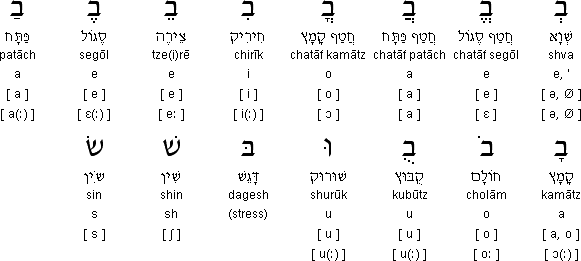 So, in order to read pointed Hebrew, one has to memorize the little dots. For example, the first vowel on the list, a patach, looks like an underscore _ under the bet, but it is really a pointed vowel. Full-blown Hebrew has no _'s in it and one needs to be smart enough to know which is which. So make matters worse, look at the last vowel, a kamatz, this is a T under the bet. It makes the same sound, or similar enough that I'm not supposed to learn the difference. Oi! I guess I'll just learn Hebrew and be done with it.
 By the way, it is a fun language to learn. I do recommend it.
Tuesday, January 1, 2008
Introduction
This is to serve as a more academic relation to my other blog. I have a tremendous fear of "academic" writing, so I will write her to get the nerves out. I do welcome comments, both on quality and on the topic, but please be nice--there is a real person behind this blog.
Leading
There are a few things I've learned about leadership while watching people at Seminary. One of the biggest things is that sometimes leading means not being in control. And sometimes the best thing for a group is to relinquish that control and not force it.
One example of such control is during the liturgy, especially during the praying of the Lord's Prayer. Most everyone in Seminary has to "lead" the prayer, which means that no one is praying. Also, it adds to the confusion of who to follow. If everyone has a different idea of which tempo to take the prayer and everyone is leading, no one will be praying together, which is, of course, the point. If none will subordinate and be part of the congregation, then no community will happen. Community is one of the reasons for liturgy.
Part of leading the liturgy, at that point, is to allow the community be that community. When the Psalms are being sung or read it is the same situation. If every person tries to chant at a different rate, then the Psalms are pointless. We are only a community when we lose control and let these things happen.
However, the other side is that there needs to be someone to start things. If it was time for the Lord's Prayer and there was no appointed leader to start the prayer, the congregation would be lost and not pray then either. Likewise, if the organist allowed the congregation to simply sing how they wanted to, the congregation may not be able to sing many of the hymns accurately. This is particularly a problem since the organist must be sensitive to what the congregation needs from them. Sometimes they need to follow the congregation's tempo, sometimes they need to follow the organist's.
I guess this is part of the tricks that musicians and other leaders in the church or other groups need to realize and be sensitive. The reason I brought it up was that the "congregation" at Seminary has yet to realize that they need to be a community in order to be a congregation, without the quotes.
One example of such control is during the liturgy, especially during the praying of the Lord's Prayer. Most everyone in Seminary has to "lead" the prayer, which means that no one is praying. Also, it adds to the confusion of who to follow. If everyone has a different idea of which tempo to take the prayer and everyone is leading, no one will be praying together, which is, of course, the point. If none will subordinate and be part of the congregation, then no community will happen. Community is one of the reasons for liturgy.
Part of leading the liturgy, at that point, is to allow the community be that community. When the Psalms are being sung or read it is the same situation. If every person tries to chant at a different rate, then the Psalms are pointless. We are only a community when we lose control and let these things happen.
However, the other side is that there needs to be someone to start things. If it was time for the Lord's Prayer and there was no appointed leader to start the prayer, the congregation would be lost and not pray then either. Likewise, if the organist allowed the congregation to simply sing how they wanted to, the congregation may not be able to sing many of the hymns accurately. This is particularly a problem since the organist must be sensitive to what the congregation needs from them. Sometimes they need to follow the congregation's tempo, sometimes they need to follow the organist's.
I guess this is part of the tricks that musicians and other leaders in the church or other groups need to realize and be sensitive. The reason I brought it up was that the "congregation" at Seminary has yet to realize that they need to be a community in order to be a congregation, without the quotes.
Subscribe to:
Posts (Atom)