There are a few things I've learned about leadership while watching people at Seminary. One of the biggest things is that sometimes leading means not being in control. And sometimes the best thing for a group is to relinquish that control and not force it.
One example of such control is during the liturgy, especially during the praying of the Lord's Prayer. Most everyone in Seminary has to "lead" the prayer, which means that no one is praying. Also, it adds to the confusion of who to follow. If everyone has a different idea of which tempo to take the prayer and everyone is leading, no one will be praying together, which is, of course, the point. If none will subordinate and be part of the congregation, then no community will happen. Community is one of the reasons for liturgy.
Part of leading the liturgy, at that point, is to allow the community be that community. When the Psalms are being sung or read it is the same situation. If every person tries to chant at a different rate, then the Psalms are pointless. We are only a community when we lose control and let these things happen.
However, the other side is that there needs to be someone to start things. If it was time for the Lord's Prayer and there was no appointed leader to start the prayer, the congregation would be lost and not pray then either. Likewise, if the organist allowed the congregation to simply sing how they wanted to, the congregation may not be able to sing many of the hymns accurately. This is particularly a problem since the organist must be sensitive to what the congregation needs from them. Sometimes they need to follow the congregation's tempo, sometimes they need to follow the organist's.
I guess this is part of the tricks that musicians and other leaders in the church or other groups need to realize and be sensitive. The reason I brought it up was that the "congregation" at Seminary has yet to realize that they need to be a community in order to be a congregation, without the quotes.
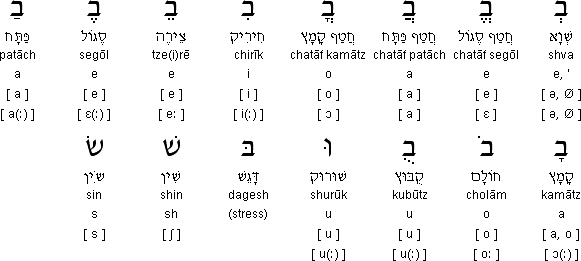 So, in order to read pointed Hebrew, one has to memorize the little dots. For example, the first vowel on the list, a patach, looks like an underscore _ under the bet, but it is really a pointed vowel. Full-blown Hebrew has no _'s in it and one needs to be smart enough to know which is which. So make matters worse, look at the last vowel, a kamatz, this is a T under the bet. It makes the same sound, or similar enough that I'm not supposed to learn the difference. Oi! I guess I'll just learn Hebrew and be done with it.